



Journal selection is one of the most consequential decisions in a researcher's career, and most people make it without a real system. This guide walks through a practical strategy that protects your time, fits your paper to the right audience, and keeps your sanity intact.
Choosing where to submit a paper sits at the beginning of the publishing process, before formatting, before cover letters, before you open the submission portal. It is also where a lot of researchers lose the most time.
The usual advice is something like: check the journal's scope, look at the impact factor, aim high. That's not wrong, but it skips the part where a mismatch between your paper and a journal's audience costs you two to four months of waiting, a desk rejection, and the task of starting over.
This guide covers how to build a journal selection strategy that is practical and accounts for the time pressure most researchers are actually under. It covers the emotional side of the decision, how to use citation mapping tools like Litmaps to surface journals you wouldn't find through keyword searches, why local journals matter more than most citation metrics suggest, and how to check your paper's fit before you submit.
1. The real cost of getting it wrong
What does a wrong journal choice actually cost?
First-decision times at most journals run between six and twelve weeks. That is just how long the process takes before you hear anything. If the decision is a desk rejection, you have spent that time waiting for a no that had nothing to do with the quality of your work and everything to do with fit.
Erik Jia from Manusights puts it plainly: "Each wrong journal attempt burns 3–8 weeks of irreversible career time. Two wrong choices back-to-back costs you 3–6 months."
For a PhD student on a four-year programme, or a postdoc on a two-year contract, this is a substantial amount of time. A rejection from a journal that was never a real fit for your paper might mean you don’t get any useful feedback either.
The reason this happens is that journal selection often gets treated as the last step in writing a paper, something to sort out once the manuscript is finished. In practice, thinking carefully about where you are going to submit before you finish writing saves you from writing for the wrong audience, which is its own kind of work to undo.
Pitfall: Submitting to a prestigious general journal because it is the most obvious name in your field. Journals like Nature or Science reject around ninety percent of submissions, often at the desk, because they are selecting for papers with a very broad scientific audience. A solid, well-executed study in a highly specialized area (for example a clinical workflow) may not fit their audience.
2. The strategy duel: aim high or stay realistic?
How do you decide where to aim?
The advice to aim high and the advice to be realistic are both correct, depending on what you mean by each. The version of "aim high" that costs researchers the most time is submitting to a journal with no real connection to your subfield, hoping the impact factor carries you through.
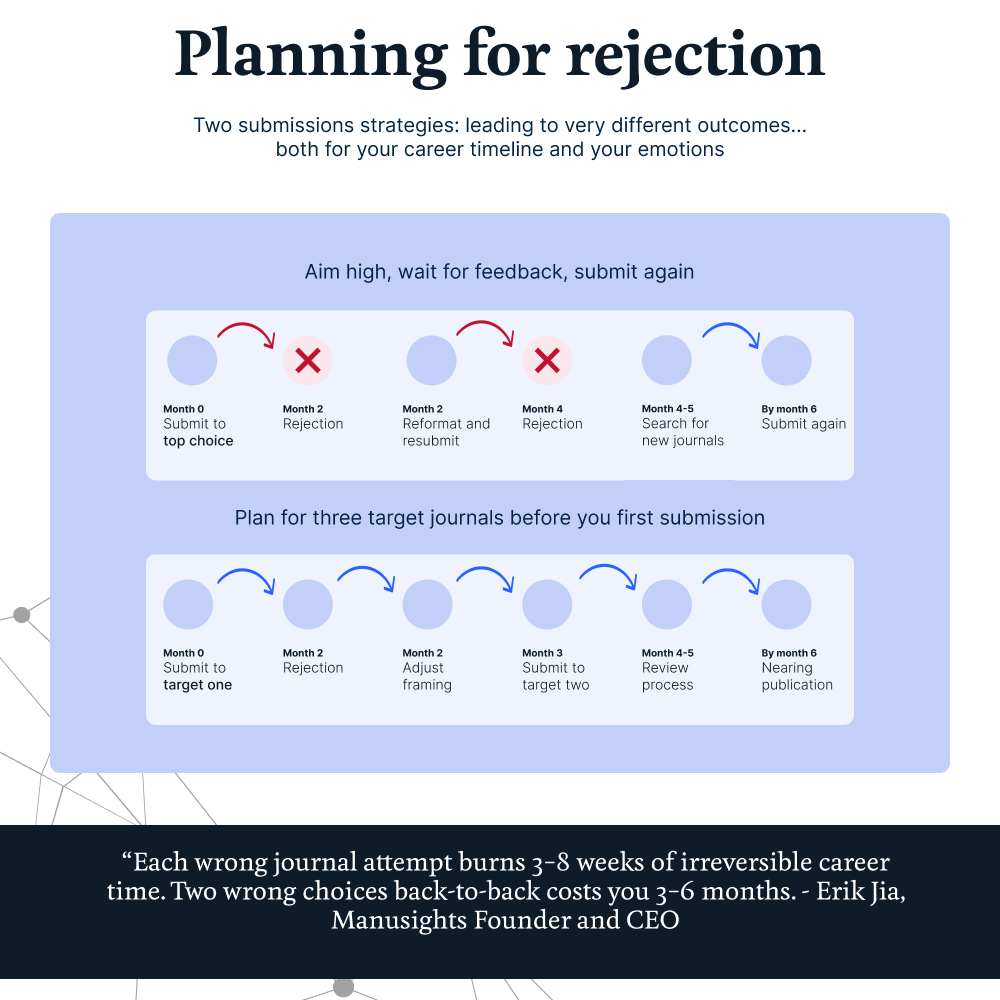
Dr. Helen Murray from the University of Auckland describes a more considered version of aiming high: "When choosing where to publish, I prioritize the journals I read most and aim high, submitting first to top-tier journals in my field. I've been desk rejected many times, but I treat those as opportunities to improve."
The key phrase there is "journals I read most." She is not submitting to the highest impact factor she can find. She is submitting to the journals that are already publishing the conversations she is part of.
A useful way to structure this is what Manusights calls a three-tier cascade strategy. Before you submit anywhere, you identify three targets:
- Target 1 is your ambitious stretch. The best-fit high-impact journal in your area, not the most famous journal in the world.
- Target 2 is a strong alternative with a different audience or faster turnaround.
- Target 3 is a reliable specialty journal where your paper clearly belongs.
Having all three identified before you submit means that if Target 1 rejects you, you are not starting from scratch. You already know where you are going next.
One important note on moving between targets: do not submit the same manuscript unchanged. Each journal has a different readership, and what reads as a broad contribution at Target 1 may need to be reframed as a focused, mechanistic finding at Target 2. That reframing is usually a matter of adjusting the introduction and abstract, not rewriting the paper.
The emotional side of rejection is important to consider but reframing this as genuinely useful feedback and having your target 2 and 3 journals lined up can make this easier.
The ESCP Commentary by Wirth et al. (2024) puts it this way: "It is reasonable to feel disappointed upon receiving peer review feedback, however it is crucial not to respond to comments impulsively. Successful publishing requires preparation, perseverance, diligence and learning from disappointments."
That is not a platitude. Waiting twelve weeks for a rejection can feel genuinely demoralizing, and researchers who respond by rushing the next submission tend to repeat the same fit problems. Building your submission targets before you submit gives you somewhere to go without making a hasty decision under stress.
Pitfall: Treating Target 2 as a backup you'll figure out later. If you don't have it identified before you submit to Target 1, a rejection puts you back at the research stage at exactly the moment you have the least motivation to do it carefully.
3. How to find journals you've never heard of
What if the right journal isn't one you already know?
The most reliable starting point for finding journals is your own reference list. Look at the ten to fifteen papers most central to your argument and note where they were published. Those journals are already running the conversation your paper wants to join. If you've cited a journal three times in your manuscript, that is a reasonable signal that your paper might belong there.
The limitation of this approach is that it only surfaces journals you already know well enough to have cited. In interdisciplinary fields like clinical pharmacy, health economics, or health services research, the most relevant work sometimes comes from adjacent fields that your bibliography doesn't fully represent.
This is where citation mapping tools become useful. Litmaps lets you input a set of seed papers and then maps citation networks visually. You can see not just what your key papers cited, but what cited them, and what cited those. Clusters of papers that keep appearing in that network, especially ones you haven't read yet, often come from journals you wouldn't have found by typing your topic into a search engine.
The practical workflow looks like this:
- Start with your seed papers. Take the five to eight papers most central to your argument and add them to a Litmap in the Explore view.
- Run the discovery feed. Litmaps surfaces related papers based on citation connections. Review these for ones you haven't cited but probably should have.
- Note the journals. As you find relevant papers you hadn't encountered before, track where they were published. A journal appearing repeatedly in your citation network is worth a closer look.
- Check the aims and scope page. Once you have a shortlist of unfamiliar journals, read their aims and scope carefully. Impact factor alone tells you very little about whether your paper fits.
Pitfall: Stopping your journal search once you have one good option. A single target with no alternatives puts you back at square one after a rejection. Run the citation mapping process before you finish writing, so you have a full list to draw from when you build your target list.
4. Why local journals deserve a place in your plan
Should you always be aiming for international reach?
Associate Professor Sereana Naepi from the University of Auckland describes her publishing strategy this way: "My publishing strategy is to place about 50% of my work in localised journals and 50% in larger international ones. If we stop publishing in domestic journals, they risk disappearing."
Local and regional journals exist because research communities need somewhere to publish work that is specific to their context. If researchers in those communities systematically redirect their best work toward international journals for the sake of citation metrics, the regional journals lose submissions, lose prestige, and eventually close.
There is also a more immediate practical argument. If your study evaluates medication adherence in a regional community health setting, or examines a policy change specific to a national health system, the people who can act on your findings are working in that system. A pharmacist or a policymaker in that region is more likely to encounter your paper in a domestic journal they already read than in an international journal with a global subscriber base.
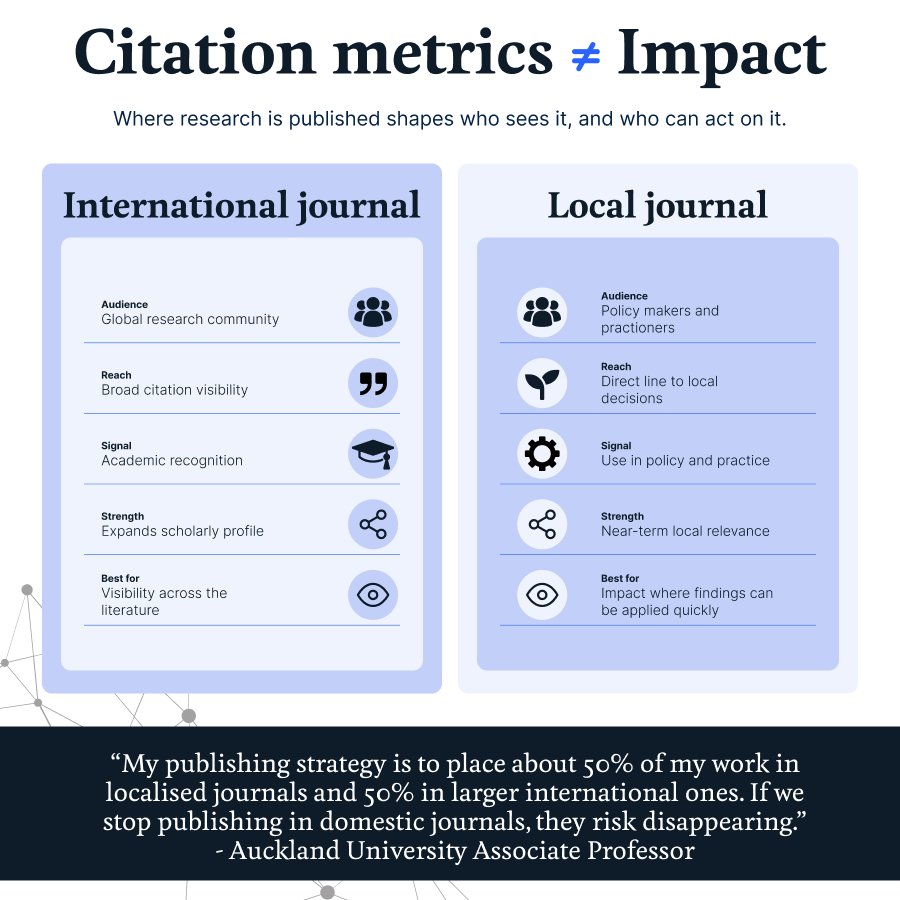
Chasing a higher Journal Impact Factor does not always mean your research reaches more of the people who need it. For applied, policy-relevant, or community-based research, it sometimes means the opposite.
This does not mean avoiding international journals. It means being deliberate about which papers go where, based on who the actual audience is and where the findings can be put to use.
Pitfall: Assuming that a lower impact factor means a less important publication. For research with a specific regional or policy audience, a well-read domestic journal can produce more real-world uptake than a higher-ranked international one that the relevant practitioners never open.
5. Working with editors, not around them
How do you get a clearer read on whether a journal is actually right for your paper?
Most researchers experience the editorial process as opaque. You submit, you wait, and then you receive a decision that arrives without much explanation of how it was made. That experience tends to frame editors as gatekeepers, which makes the whole process feel more adversarial than it needs to be.
One concrete development worth knowing about is ECRAB, the Early Career Researcher Advisory Board, formally established in Basel in June 2024 by the International Collaboration of Pharmacy Journal Editors (ICPJE). The board was set up to act as a sounding board between early-career researchers and journal editors, with the goal of co-creating publishing guidelines and making the review process more legible to people who are newer to it.
The significance of ECRAB is less about that specific board and more about what it represents. Journals are increasingly aware that the submission process is confusing and discouraging for early-career researchers, and some are building structures to address that. When you are evaluating a journal, it is worth checking whether they have an early-career board, an editorial advisory structure, or publicly available reviewer guidelines. Journals that have invested in making the process clearer are generally easier to work with.
There is also a more direct option for testing fit before you commit to a full submission. Most journals accept pre-submission inquiries, usually a short email under two hundred words summarizing your study and asking whether the paper falls within the journal's current scope. Editors respond quickly to these, often within a week, and a positive response saves you the work of formatting a full submission for a journal that was never going to take the paper.
Pitfall: Skipping the pre-submission inquiry because it feels like an extra step. If you are uncertain about fit, especially for a journal you haven't published in before, a short inquiry takes thirty minutes and can save you two months.
6. Pre-submission checklist: rate your paper's fit before you submit
Give your manuscript one point for every yes you can honestly answer.
The bibliography test. Have you cited at least two or three papers published by this journal in the last two years? Citing a journal's recent work is a signal that you are already part of the conversation they are running.
The figure count check. If the journal's typical paper has seven or eight figures and tables, does your paper have comparable depth of data? A large gap in either direction can signal a completeness mismatch.
The local relevance check. Does your research address a localized policy or regional health system question? If yes, is your target journal domestic or closely aligned with that regional context?
The MeSH term check. Have you optimized your abstract and title using standardized Medical Subject Headings (MeSH) so that indexing algorithms can find your paper? Discoverability depends on this more than most researchers realize.
The editorial board check. Is there at least one editor on the board whose research interests overlap with your subfield? Having someone on the board who works in your area increases the chance your paper reaches a reviewer who understands it.
The target check. Do you have Target 2 and Target 3 identified, with notes on how you would reframe the introduction for each?
Scoring:
- 5–6 points: Your alignment looks strong. Submit with confidence.
- 3–4 points: Consider sending a pre-submission inquiry of under two hundred words before committing to a full submission.
- 0–2 points: Your paper risks a desk rejection at this journal. Re-evaluate your targets or adjust your framing before you submit.
7. Common mistakes
Selecting a journal after the paper is finished. The journal you are writing for shapes decisions about framing, scope, and audience that run through the whole manuscript. Leaving the decision until the end often means you have written for no particular reader.
Using impact factor as a proxy for fit. A journal's impact factor tells you how often its papers get cited on average. It does not tell you whether your specific paper fits the journal's scope, audience, or current editorial priorities. Two journals can have identical impact factors and be looking for completely different kinds of work.
Submitting the same manuscript unchanged to multiple journals in sequence. Each journal has a different readership. What reads as a novel contribution to one audience may read as a narrow, specialist finding to another. The reframing between targets is usually small, but skipping it tends to produce the same misalignment that caused the first rejection.
Ignoring desk rejection signals. A desk rejection, where the editor declines without sending the paper to reviewers, almost always means a fit problem rather than a quality problem. If you receive one, read the journal's aims and scope again before submitting elsewhere. The issue is usually visible in hindsight.
Treating the pre-submission inquiry as optional. For journals you are uncertain about, especially ones outside your usual publication orbit, a short inquiry takes less time than formatting a full submission and gives you a direct signal from the editor.
8. Tips worth keeping
Read the aims and scope page as if you are a reviewer, not an author. Ask whether your paper answers a question the journal's readers are likely to have, not whether your paper could technically fit within the journal's broad remit.
Track where your citations come from. As you read and save papers during your literature review, note the journals they come from. By the time you finish writing, you will have a short list of active journals in your area without doing any extra work.
Use citation mapping early. Running a citation map in Litmaps at the start of your literature review, rather than at the end, means you find relevant adjacent journals while you still have time to read and cite their recent work, which strengthens your bibliography test score before you submit.
Give yourself a decision deadline. Researchers often spend weeks in low-grade uncertainty about where to submit. Set a date by which you will have your three-tier cascade finalized and move on. The additional deliberation after that point rarely changes the outcome.
Keep a submission log. A simple spreadsheet with the journal name, submission date, decision date, and outcome gives you data over time. After three or four submission cycles you will have a clearer picture of which journals turn around decisions quickly, which ones tend to fit your work, and where your time goes.
Conclusion
Journal selection takes more thought than most researchers give it, and the cost of getting it wrong is measured in months. Building a target list of three more journals before you submit, using citation mapping to surface journals you haven't encountered yet, checking your paper's fit against a short scorecard, and treating local journals as a genuine part of your strategy rather than a fallback, these are all things you can put in place before your next submission.
A bad journal fit often means months spent waiting on a rejection that a closer read of the journal's aims and scope page could have caught early. The checklist in section 6 is designed to catch that before you hit submit.
If you want to explore your citation network and find journals you haven't come across yet, Litmaps is a good place to start. The Explore view lets you map connections across your seed papers and surface related work that keyword searches tend to miss.
If you want to find out if your manuscript is ready for your target journal Manusights offers a free readiness check. It takes just a few minutes and you’ll find out what an editor might flag in your draft.
Further reading and article sources
Jia, E. (2025, October 29). How to choose the right journal for your paper (A practical guide). Manusights. https://manusights.com/blog/how-to-choose-journal-for-paper
University of Auckland. (n.d.). What journal should I publish in? https://www.auckland.ac.nz/en/research/research-resources/publishing-communication-profiles/publishing/journal-selection-strategies/what-journal-should-publish.html
Alves da Costa, F., et al. (2025). The International Collaboration of Pharmacy Journal Editors (ICPJE) formally constituted to foster quality around clinical and social pharmacy practice research publications. Exploratory Research in Clinical and Social Pharmacy, 19, Article 100519. https://doi.org/10.1016/j.rcsop.2024.100519
Wirth, F., et al. (2024). Writing a manuscript for publication in a peer-reviewed scientific journal: Guidance from the European Society of Clinical Pharmacy. International Journal of Clinical Pharmacy, 46, 548–554. https://doi.org/10.1007/s11096-023-01695-6




Comments
Add Comment